
Contractual Risk Routing: Linking Obligations to Board Objectives
Your contracts contain obligations. Your board has objectives. If the two are not connected, your governance has a structural gap. Here is how contractual risk routing closes it.
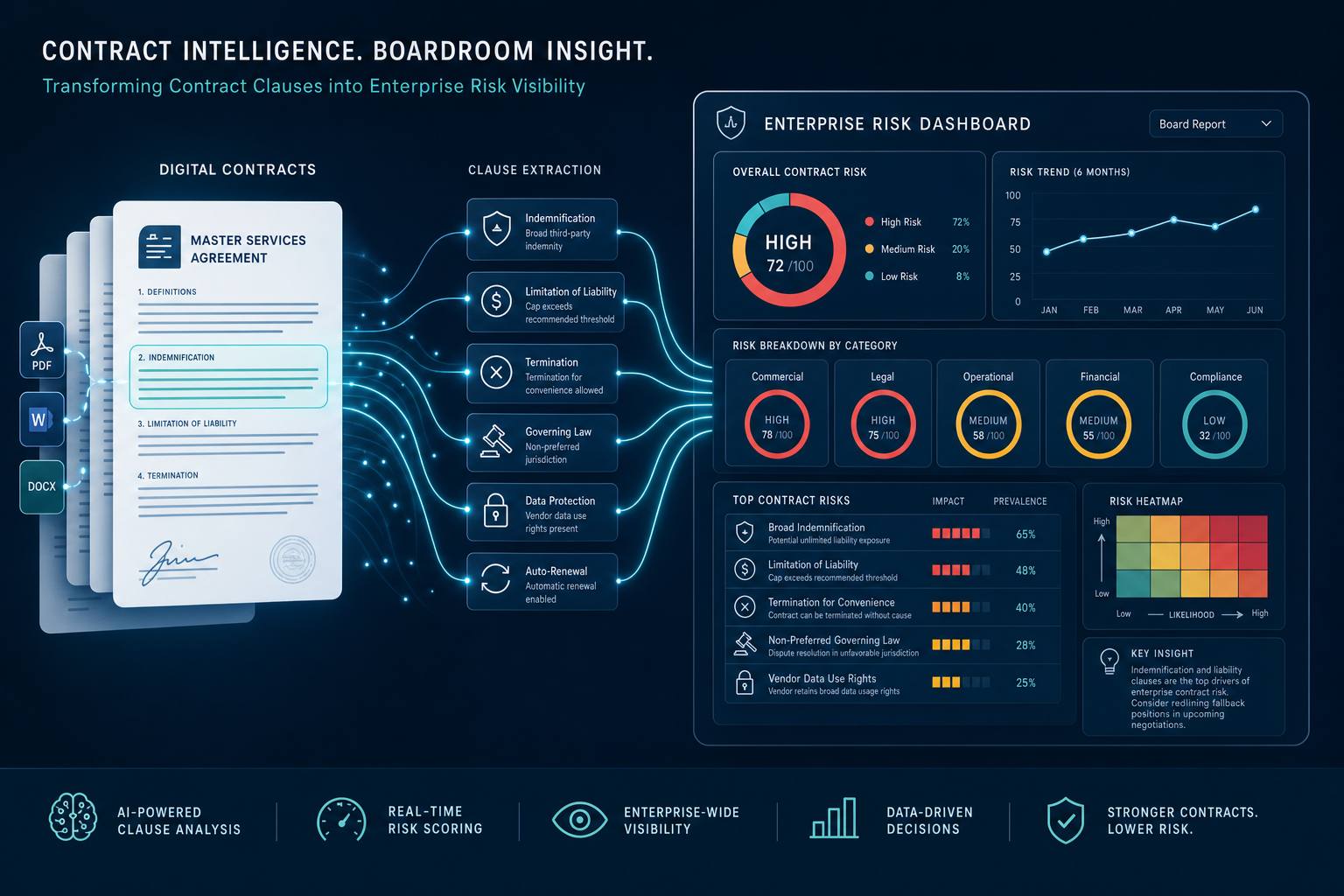
Your contracts are not legal documents. They are operational obligations.
Every signed contract contains commitments: delivery dates, service levels, penalty clauses, renewal windows, compliance requirements, indemnity limits. These obligations directly affect your operational risk, your cash flow, and your strategic objectives.
And yet, in most UK mid-market organisations, contracts live in a folder. Disconnected from the risk register. Invisible to the board. Managed by memory and calendar reminders.
This is the contractual governance gap. And it is where the Rasmussen drift begins.
What Is Contractual Risk Routing?
Contractual Risk Routing is the practice of systematically linking contract obligations to specific board-level objectives and risk register entries - so that a change in contractual status automatically surfaces as a governance signal.
It means that when a critical vendor contract is 30 days from expiry, the board does not find out from a panicked email. The risk register already knows. The PMO already knows. The board report already reflects the exposure.
Contractual Risk Routing: obligations flow from contracts into the risk register and board reports automatically.
Why Are Contracts a Governance Blind Spot?
Three reasons:
- Legal vs. Operational framing. Contracts are treated as legal artefacts (signed, filed, forgotten) rather than operational instruments (active, monitored, governed). The legal team signs off. The operations team never sees the obligations.
- No structural linkage. There is no connection between the contract management system (if one even exists) and the risk register, PMO, or board reporting. They are separate worlds.
- Renewal amnesia. Critical contracts auto-renew or lapse because nobody was tracking the notice period. By the time someone notices, the commercial leverage is gone.
What Obligations Should Route to the Board?
Not every clause needs board attention. But these categories do:
- Material financial obligations - contracts above a defined threshold (e.g., £100K+ annual value).
- SLA-linked dependencies - where a vendor's service level directly affects your operational delivery.
- Compliance-linked clauses - data processing agreements, regulatory obligations, audit rights.
- Renewal and termination windows - especially where auto-renewal could lock you into unfavourable terms.
- Indemnity and liability caps - where the contractual exposure exceeds your risk appetite.
- Change of control clauses - critical in M&A scenarios where a deal could trigger contract termination.
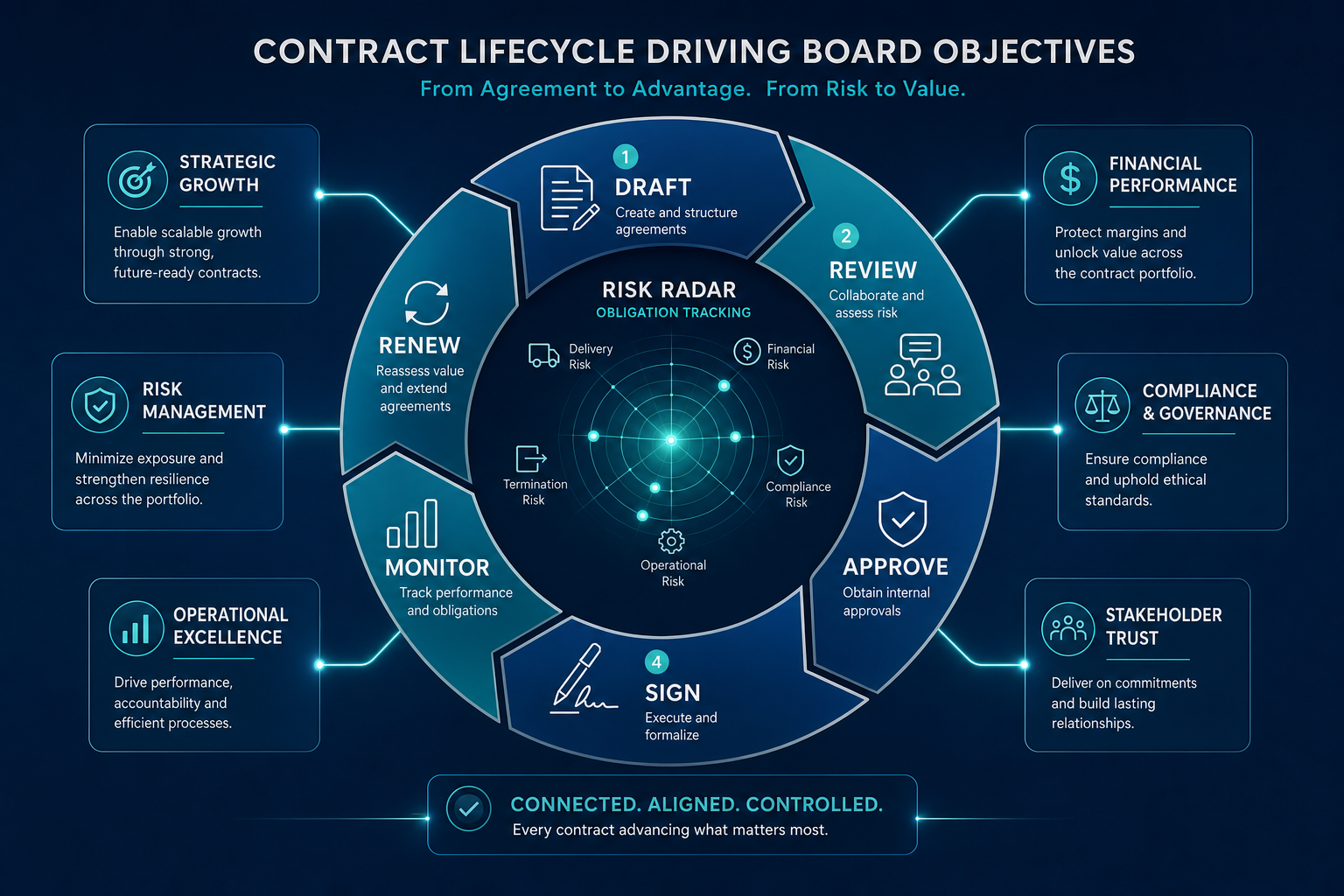
The contract lifecycle wheel: every stage generates obligations that should route to the risk register and board reporting.
How Do You Implement Contractual Risk Routing?
- Classify your contracts by risk tier. Not all contracts are equal. Define a tiering model (Tier 1: board-level, Tier 2: management-level, Tier 3: operational).
- Extract key obligations. For every Tier 1 and Tier 2 contract, identify the obligations that carry operational risk: deadlines, SLAs, compliance requirements, financial commitments.
- Map obligations to board objectives. Each material obligation should link to a specific board objective or risk register entry. "This SLA affects Objective 3: Operational Resilience."
- Automate the signals. When an obligation status changes (approaching deadline, SLA breach, renewal window opening), the linked risk register entry and board report should update automatically.
- Review the routing quarterly. Contracts change. Objectives change. The routing must be a living map, not a one-time exercise.
What Does Good Contract Governance Look Like?
In a mature operation:
- The board sees a contract risk summary alongside the risk register - not as an afterthought, but as a core governance input.
- The PMO knows which projects depend on which contracts - and what happens if those contracts lapse or breach.
- The GRC function can trace a compliance obligation from its source (the contract) through to its evidence (the control) and its outcome (the board report).
- Nobody is surprised by a contract renewal. Ever.
The Bottom Line
If your contracts are in a folder and your risk register is in a spreadsheet, there is a structural gap between what the board thinks it knows and what the operation is actually exposed to.
Contractual Risk Routing closes that gap. It turns contracts from legal artefacts into governance signals.
Simplif-i connects your Contract module directly to your GRC, PMO, and Board reporting. Obligations route to risks. Renewals trigger alerts. The board sees the full picture.
Founding Member pricing: £149/month. Less than the penalty clause you did not see coming.
✨ Recommended For You
Stop Leaking Cash: Why Your Contract Management is a Commercial Liability
Your contracts are not just legal files; they are the financial skeleton of your business. If you are not managing them proactively, you are losing ROI every single day through missed renewals and uncaptured obligations.
Force Majeure in 2026: Why Your Contracts Still Are Not Prepared for the Next Disruption
80% of UK SME contracts have weak or outdated force majeure clauses. After COVID, supply chain crises, and geopolitical disruption, here is how to fix your contract resilience before the next shock. Contracts module from £49/month.
Contract Renewal Risk & Penalty Clauses: A UK SME Survival Guide | Simplif-i
UK SMEs face tightening penalty clause regulations and renewal traps that cost thousands. Learn how to identify, track, and neutralise contract risk before it hits your bottom line.
Keep contract obligations in view
Organise agreements, obligations and renewal dates in Simplif-i.